

Address:
K-30 B, Basement, Kalkaji, New Delhi – 110019

Phones:
011-796-37823, +91 971-806-3158
Today's Appointments: 0
Address:
K-30 B, Basement, Kalkaji, New Delhi – 110019
Phones:
011-796-37823, +91 971-806-3158
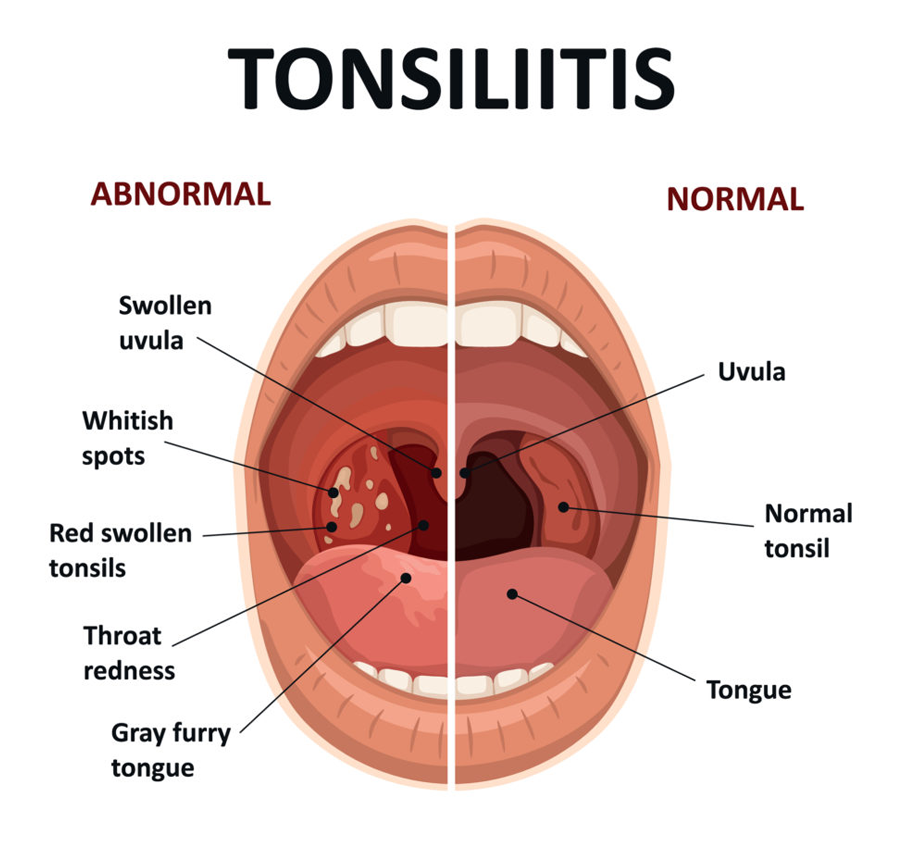
UNDERSTANDING TONSILLITIS AND ITS MANAGEMENT
ACUTE TONSILLITIS: Acute Tonsillitis is one of the most common infections encountered in everyday practice.
AETIOLOGY
PATHOLOGY TYPES
SYMPTOMS
SIGNS
DIFFERENTIAL DIAGNOSIS
| Diphtheria | Acute ulcerative Tonsillitis | Diphtheria |
| 1. History | Recurrent tonsillitis | May have been exposed to a case of diphtheria |
| 2. Temperature | High | Low or Normal |
| 3. Tachycardia | In proportion to fever | Out of proportion to fever, weak pulse |
| 4. Toxaemia | Absent | May be present |
| 5. Pain | Severe | Mild or Absent |
| 6. Membrane Surface Limited to the tonsil | Can be easily removed May extend beyond the tonsils | Separates with difficulty and leaves a raw bleeding |
| 7. Lymph nodes | Enlarged | May be markedly enlarged (bull neck) |
| 8. C. diphtheriae | Absent | Present |
| 9. Albuminuria | absent | Often Present |
There may be unilateral or bilateral ulceration. The fever is high initially. The causative organisms are Spirochaete and Bacillus Fusiformis, which can be easily demonstrable in wet hanging-drop preparation. This condition responds to penicillin and its derivatives.
The pain is severe, unilateral and accompanied by swelling of the anterior pillar and oedema of the uvula
COMPLICATIONS
TREATMENT
Homeopathic Management: There are very effective remedies for acute management of Tonsillitis and are prescribed based on patients symptoms and characteristic presentation/ concomitants. Remedies should be taken on advice of a registered homeopathic practitioner only.
CHRONIC TONSILLITIS
Chronic Tonsillitis is one of the commonest chronic infections, characterized by recurrent acute attacks.
SYMPTOMS
SIGNS
On squeezing the tonsils, pus may ooze out. It should be distinguished from the lymphatic fluid, which may come out from a normal tonsil.
Presence of persistent enlarged jugulodigastric nodes is a significant sign.
SEPTIC FOCUS
Chronic tonsillitismay produce effects on distant organs of the body by acting as a septic focus, due to bacteraemia or because of allergic reaction to bacteria and products of inflammation.
TREATMENT
FOOD SUGGESTED
FOODS TO BE AVOIDED
HOMEOPATHIC MANAGEMENT
Acute and chronic tonsillitis both fall under the scope of Homeopathy For acute attacks are various remedies which can be prescribed based on symptoms of the case. Some examples are given below. For complete treatment of chronic or recurrent sinusitis one must see a homeopathic practitioner. A homeopath in such a case will prescribe a holistic remedy covering the totality based remedy which will boost immunity and reduce or remove the tendency to tonsilitis.
Some drugs which are helpful for treating tonsillitis are as follows-
ACONITE
Red, dry, constricted, numb, pricking, burning and stinging pain. Tonsils swollen And dry.
AILANTHUS GLANDULOSA
Inflammed, oedematous, duskyred. Much swelling external and internal. Dry, rough,scraping, choking feeling. Neck tender and swollen. Hoarse croupy voice and pain in swallowing extending to ears.
AMMONIUM MUR
Throbbing pain in tonsils, can scarcely swallow. Sore spot behind uvula .Feels relieved by eating. Internal and external swelling with phlegm which is so tough that it cannot be hawked up.
APIS
Constricted stinging pain, uvula swollen, sac like puffy, fiery red, ulcers on tonsils with fiery red margins around leathery membrane. Sensation of fish bone in throat.
BAPTISIA
Dark redness of tonsils causing difficulty in swallowing solid food. Painless sore throat and offensive discharge
BARYTA CARB
Sub maxillary gland and tonsils swollen. Takes cold easily with stitching and smarting pain. Acts best on quinsy from cold. Tonsils inflamed with swollen veins which cause pain aggravation by empty swallowing. Can swallow liquid.
BARYTA MUR
Difficulty in swallowing. Tonsils enlarged paresis of pharynx and Eustachian tube with sneezing and noises.
BELLADONNA
Dry as if glazed, angry looking congestion aggravating right side, constricted feeling with difficult deglutition which is aggravated with liquid. Sensation of lump.
CAPSICUM
Pain and dryness in throat extending to ears. Sore throat of smokers and drinkers. Burning constriction worse between acts of deglutition.
DULCAMARA
Acts on mucous membrane of glands. Causative factors are dampness and cold.
EUCALYPTUS
Relaxed and aphthous condition of throat with increase d salivation,burning and feeling of fullness. Constant sensation of phlegm in throat. Enlarged, ulcerated tonsils and inflamed throat use tincture locally.
FERRUM PHOS
Mouth hot with red fauces with inflammation. Ulcerated sore throat with red and swollen and red tonsils. Sore throats of singers. After operations on throat to control bleeding and relieve soreness.
GELSIMIUM
Difficult swallowing especially of warm food. Throat feels rough and burning. Remedy for post diphtheritic paralysis. Shooting pain into ears. Feeling of lump in throat which cannot be swallowed. Swallowing causes pain in the ear, difficulty in swallowing. Pain from throat to ear.
GUAICUM
Throat dry,burns,swollen, stitches towards ear. Remedy for acute tonsillitis and syphilitic throat.
HEPAR SULPH
Quinsy with impending suppuration. Stitches inthroat extending to the earswhen swallowing. Hawking up of mucus.
KALI BICHROME
Fauces red and inflamed, dry and rough. Pesudo membranous deposits on tonsils. Discharge from mouth is stingy and tough.
KALI MUR
Remedy for follicular tonsillitis. Tonsils inflamed enlarged so much so that can hardly breathe. Greyish patches on tonsils. Remedy for hospital sore throat.
LACHESIS
Remedy for quinsy Dry intensely swollen internally and externally with sore throat which gets worse left side, swallowing liquids, hot drinks. Chronis sore throat with much hawking which cannot be forced up and down. Very painful this is worse with slightest pressure, touch.
LYCOPODIUM
Dryness of throat without thirst food and drink regurgitates through nose feels better by warm drinks. Swelling and suppuration of tonsils. Ulceration of tonsils beginning on right side. Diphtheria deposits spread from right to left which get worse from cold drinks.
MERCURIUS
Remedy for quinsy with difficulty swallowing after pus has formed. Sore, raw, smarting, burning of throat. Bluish red swelling with constant desire to swallow. Pain worse right side.
MERCURIUS IODATUS FLAVUS
Lacunar tonsillitis when only superficial part is involves. Cheesy exudates with offensive breathe. Swelling begins on right side with tenacious mucus. Sensation of lump with constant inclination to swallow.
MERCURIUS IODATUS RUBER
Painful swallowing with stiffness of muscles of throat and neck. Diphtheria and ulcerated sore throat especially on left side.
NATRUM SULPH
Complaints due to living in basements, damp houses and cellars which get worse in rainy weather or water in any form. Thick yellow mucus drops from posterior nares.
PHYTOLACCA
Tonsils swollen especially right side with sensation of lump in throat. Throat feels rough, narrow and hot. Shooting pain into ears on swallowing. Greyish white thick tenacious mucus discharge. Cannot swallow anything hot. Cannot swallow even water.
RHUS TOX
Left side complains with sore and sticking pain during swallowing. Ailments from getting wet while perspiring.
SABADILLA
Soreness which begins on left side with tough mucus. Warm food and drinks give relief. Empty swallowing is most painful Complains worse from cold air.
SANGUINARIA
Complains worse on right side with dry and constricted feeling. Tongue white as if scalded.
SILICEA
Periodical quinsy. Pricking as of a pin in tonsils. Cold settles in throat. Stinging pain while swallowing.
SULPHUR
Pressure as from a lump, as from a splinter, as of a hair. Burning redness and dryness.
REFERENCES
Ralston S.H., Penman I.D., Strachan M.W.J., Hobson R.P. Davidson’s, Principles and Practice of Medicine. 23rd rev.ed. Edinburgh; Churchill Livingstone/Elsevier; 2018. 1417p.
Kasper D.L., Fauci A.S., Hauser S.L., Longo D.L., Jameson J.L., Loscalzo J. Harrison’s Manual of Medicine. 19th rev. ed. United States: McGraw Hill; 2016. 1222p.
Boericke W. Pocket Manual of Homoeopathic Materia Medica. New Delhi: B. Jain Publishers (P) Ltd.; 2011
Lilienthal, S. Homoeopathic therapeutics. Philadelphia: Boericke & Tafel; 1907